Collections Strategies for Design Firms
How do you handle it when your clients get behind?
“Call them up!” says Michael Bernard. Don’t push this task off onto your bookkeeper. If the client writes the checks, the principal should make the call. “Keep your voice neutral and unemotional. Rehearse beforehand if you need to. The message is that, as a small business, cash flow is vital to your operations, and you’d appreciate them sending an immediate payment.”
“One former client felt so guilty about a tardy payment that he paid up even to his current charges that hadn’t been billed yet!”
by Rebecca Firestone with Mark English AIA
read more »
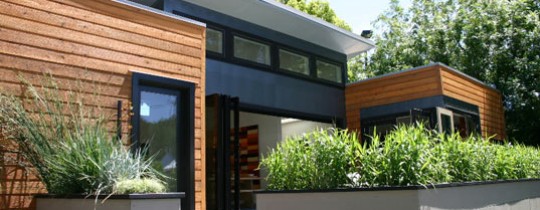
Michelle Kaufmann: Phoenix Rising
“My husband and I were looking for a place to live and all we could find was crap! We couldn’t afford anything well-designed, well-made, and energy-efficient. After seeing the thoughtless crap that was filling the landscape, we painfully decided to do something about it.
“We got a bit of property and built a little “green” house on it. Then we thought about the possibilities for mass production, and said, YES! Now, there’s no “if” when it comes to green, healthy, efficient homes. And they can be well-designed and affordable. It’s in how you make spaces, views, and light. The space should feel big, but you don’t have to build it big.”
(Photo: Sunset Breezehouse, designed and photographed by Michelle Kaufmann)
by Rebecca Firestone with Mark English AIA
read more »

Michael Bernard on Knowledge Management: What’s In It for Architects?
A recent conference, KA Connect 2010, highlighted the growing role of information technology as a driver of practice in architecture, engineering, and construction including both emerging trends and issues relevant to current practice. Over 35 speakers shared perspectives from architects, engineers, software developers, client-side construction managers, business development consultants, and outsourcing consultants. It was a rare opportunity to speculate on how to transition from present to future practice. These transitions are not painless, as anyone who’s implemented BIM can tell you. However, once in place, these new technologies and practices can result in greater integration and engagement during the design process.
by Jeff Lambert
read more »

Brooks Walker: Respectful Designs That Last
I like to say that great clients create great buildings. The collaboration between architect and client is a dynamic tension, a matrix for ideas to coalesce. Constraints can be liberating because they give you a direction. It’s an art form, like classical music or haiku. You can’t just do whatever you want.
Our goal is to create a building that is so well designed, out of such durable materials, that no one would want to knock it down later on. We have to be careful about where and how much the architect’s ego should come in. After all, we’re not the end users. We want our buildings to outlast us.
A good motto might be, “Design something like you care.”
[Cover photo by Cesar Rubio]
by Rebecca Firestone with Mark English AIA
read more »

Michael Bernard on Mentorship in Architecture
“Recently, I spoke to a group of architecture students. We had just concluded a panel discussion on career alternatives to the traditional practice of architecture. I asked the students if they intended to pursue careers outside the familiar realm of traditional practice. Out of 30 students, 25 raised their hands.
I asked a second question: how many of the students intended to engage in the effort to obtain their architectural license? In response to this question, eight students raised their hands. As I see it, the future of the architectural profession is in the hands of these eight students – and three of those eight are “on the fence” about whether to pursue a career in architecture or to explore other professional options.”
by Jeff Lambert
read more »

From Dubai to Haiti: Richard Best, Sustainable Architect
“A master plan has to take into account the natural and economic resources available in the region.…You have to think about commerce. In order for such a plan to be effective, it has to include more than pretty buildings. It has to be realistic. You can’t plan on exporting pineapples from Haiti for example – not enough arable land for it.
For sustainable development, unfortunately the best opportunities often present themselves in the form of natural disasters, such as Haiti’s recent earthquake. This is an opportunity to turn human tragedy into a triumph by creating better, more livable cities.”
by Rebecca Firestone with Mark English AIA
read more »

Are Architects and Social Media Really Compatible? (Updated)
Mark English and Jerry James are presenting at the AIA East Bay on March 4th on how small design and construction firms can adopt social media to further their own marketing strategies.
by Rebecca Firestone with Mark English AIA
read more »

Olle Lundberg: Hand of a Craftsman, Part 1
“Our firm’s work is really about small projects, carefully crafted. It expresses the hand of the builder. The role of the craftsman is so rare today. You can take something hand-crafted and replicate it by machine, but then it’s no longer craft.
I prefer materials with depth and heft, with an elemental power about them. The power comes from the natural piece that they came from, or from the way the material was created. Our palette is nature-oriented. Even steel, I consider a natural material, because it comes out of the earth.
by Rebecca Firestone with Mark English AIA
read more »
Olle Lundberg: Hand of a Craftsman, Part 2
“[With star clients] you have to be really “on”. There’s not much time to impress them… it’s that initial gesture that counts. You have to gain credence quickly, and bring something to the table that they didn’t expect. [When I get a new idea] it’s dreamlike at first. The idea has to be vague enough to be flexible, but clear enough to be able to return to it. I have to be disciplined about working quickly; ideas can dissipate like fog.”
by Rebecca Firestone with Mark English AIA