Before We Could Design Terrace House, We Had to Prove It Was Possible
by Mark English, AIA | Mark English Architects, Work/News
A three-acre lot in Woodside had passed through 10 or 11 heirs without anyone building on it. In
March 2020, two buyers asked us to figure out if the hillside site, with slopes between 30% and
50% in places, could hold a house at all.
The Terrace House was born when we got a call from two gentlemen interested in a three-acre lot in Woodside, California. For some reason unknown at the time, this very desirable property in the middle of a very desirable town was undeveloped. We didn’t know why, and neither did they.
Once we met at the site, we realized why it had sat untouched. The slope was between 30% and 50% in places, and there was no improved driveway access or other improvements to the property. Evidently, 10 or 11 people had inherited the property over the years, and no one knew whether or how it could be developed.
A perfect project for us!
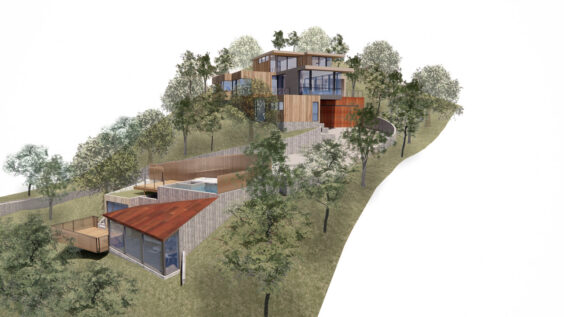
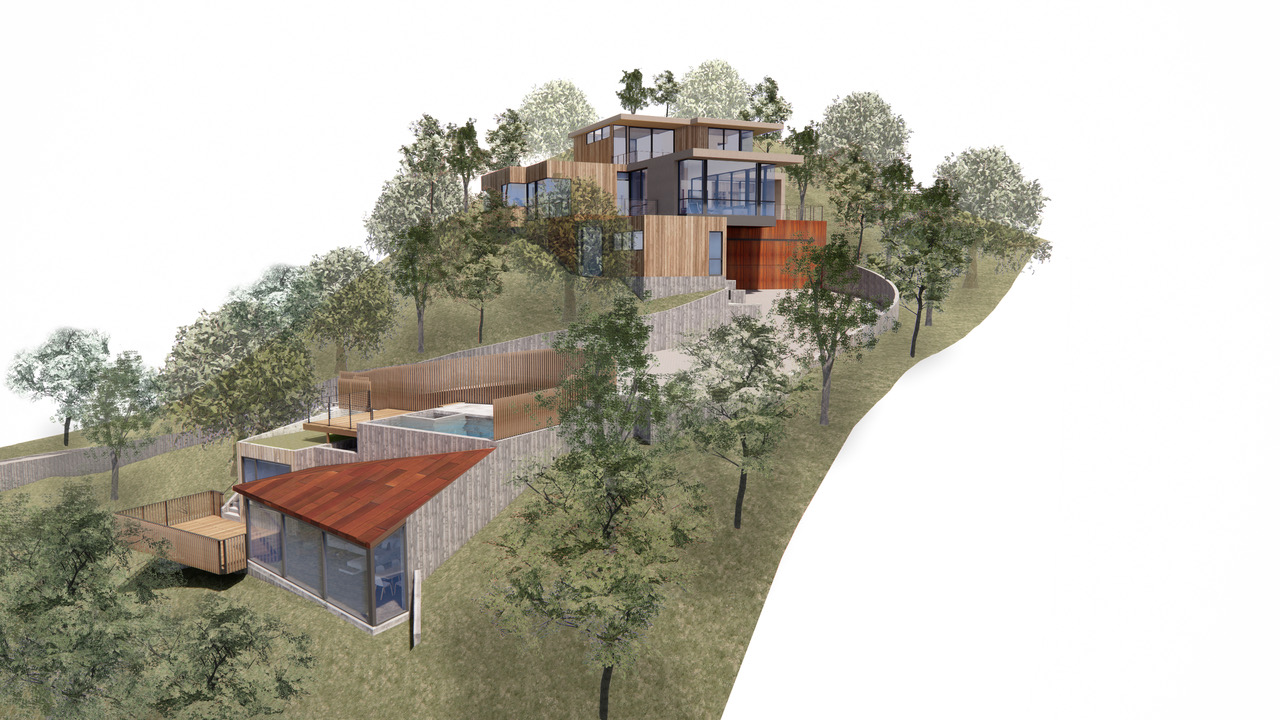
The main house steps down the Woodside hillside in three distinct levels, clad in Corten steel and stained wood siding.
We reached out to Lea & Braze Engineering, experts in civil engineering, grading, drainage, and septic systems and Jim Daily of Portola Valley Builders. One of the key issues was whether it would be possible to bring a fire truck access road up to a potential building site on the hill.
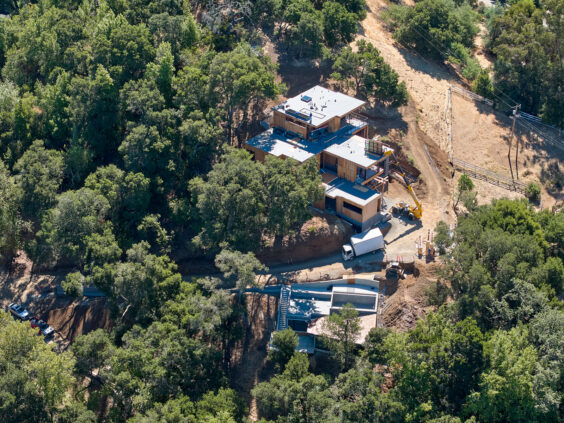
It turned out that in the short period of time the property could be held in escrow, we were able to get a topographic survey done, plan out a possible driveway and fire truck turnaround, and confirm that it was plausible that a standard septic system would work. After that, our clients purchased the property and we started design work.
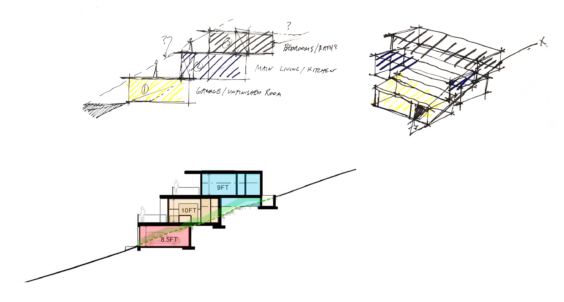
After initial site visits and design discussions, diagrams and initial sketches form the building blocks
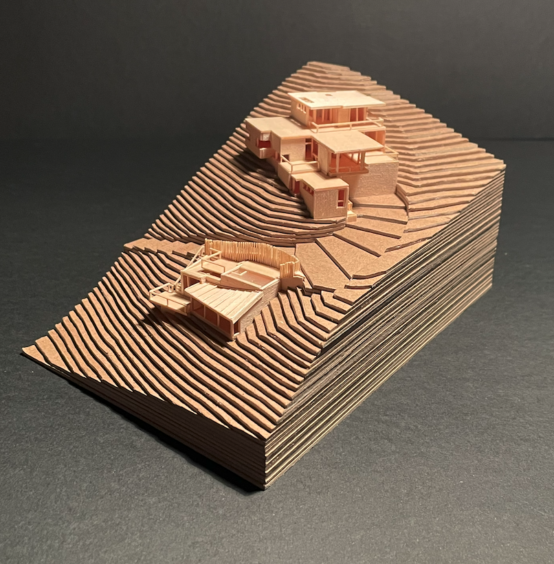
The building of physical models is helpful on a number of levels. One might argue that there is no tool that can convey the ideas of massing and relationship to the site as effectively as a model.
This all happened at the beginning of the pandemic, which made communicating efficiently with each other and with Planning officials a real challenge. Luckily, we had worked with Sage, head of the Woodside Planning Department, years before in Half Moon Bay. Sage understood how we were trying to integrate a house and an ADU into a very challenging steep slope while meeting all the requirements. He was able to help us secure variances in areas where the grade was generally too steep or where retaining walls would be higher than normally allowed. We’re thankful for the careful and deliberate guidance the Woodside Planning Department under Sage provided on this project.
Like most new homes in Woodside, this project had to go before a public Planning Commission Meeting process. Because it was a hearing in the middle of the COVID era, it happened via Zoom and went well.
The design solution resulted in two buildings. The main house is terraced into the hillside in a series of three large cuts in the earth, allowing the stepping building form to stay well under the maximum building height above grade. The building form required that the contractor coordinate and undertake more than 12 separate sequential shoring set-ups and concrete pours.
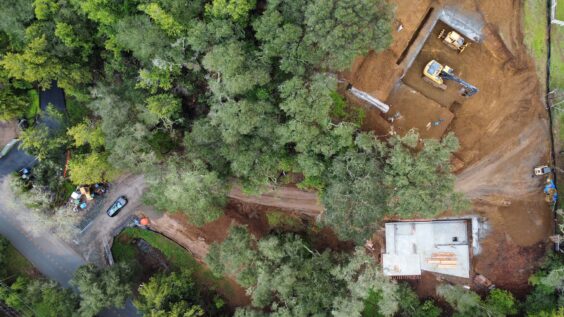
The terracing strategy let living spaces open directly to grade at multiple levels without disturbing the oak-covered hillside.
The ADU (Accessory Dwelling Unit) as a separate building was limited to around 1,200 square feet. For both buildings, we wanted to limit outdoor usable space to terraces or surfaces on the roofs. We did not want to create extensive retaining walls to flatten the site or manipulate the existing landforms more extensively than necessary. To this end we located the ADU swimming pool and outdoor terrace on top of the concrete mass of the living space itself.
The main house and the ADU have a similar material palette, which is Corten steel, stained wood siding, and integrally colored cement plaster.
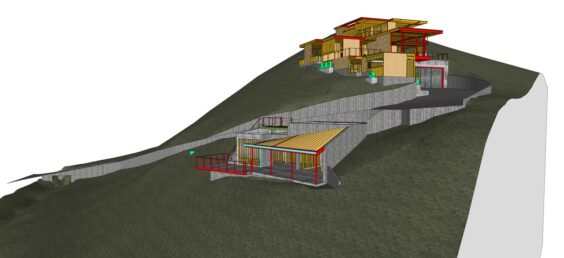
The ability to visualize a building’s complete structure from multiple perspectives is a great advantage in communicating design ideas to the owner and the builder. Quantities of site excavation work and how the foundation sits on the site are understood in a more succinct manner. The work of the structural engineer is brought together with that of the architectural form resulting in an understanding of building components and their relationships.
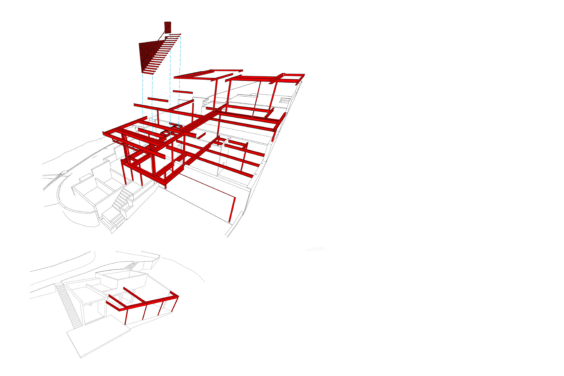
Digital visualization tools not only help present how the building will look to the owners but can also assist in the conversation with consultants and the builder on assembly and detail.
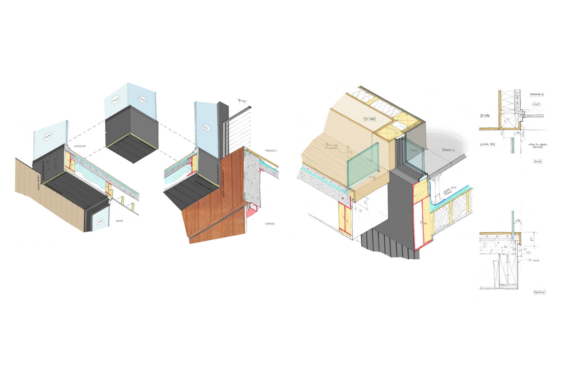
The completion of the construction drawings and issuing of the permits rarely signals the end of design development. A renewed focus on how the finishes and building systems come together is often required to refine the building. An effective means of illustrating the assembly of construction components to the builder is through hand-drawn isometric sketches.
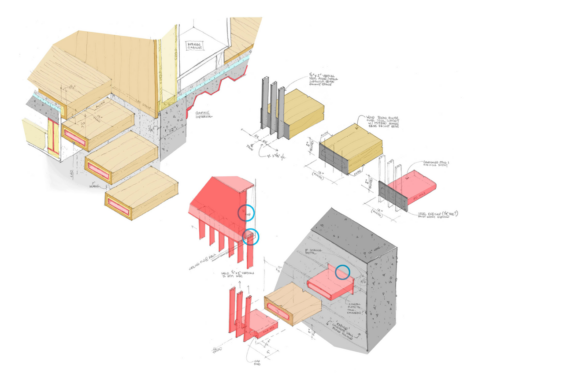
Three-dimensional pencil drawing may seem an outdated communication method. However, the thoughtful approach of hand drawing specific details can yield an understanding of how components fit together with speed and clarity. A pencil sketch can lead to future digital explorations or can illustrate design intent on their own.
Terrace House exemplifies our work in rural California. We love the challenge inherent in developing a “difficult” site, embracing its personality and creating a vibrant, unique home in the process. We have recently designed homes on the edge of a quarry, perched over the San Francisco Bay in Sausalito, and on a windswept saddle in the Preserve in Carmel Valley.
Each of the two buildings that make up the Terrace House compound, the main house and ADU, are informed by the very tight constraints found in the topography and Planning guidelines and rules. When designing the ADU warped roof, we took a digital model “mold” of the existing topography at the footprint of the building and pulled it 11 feet in the air to delineate the highest allowable extent of the building. The move satisfied both maximizing the envelope while also creating a distinctive form for the Corten roof.